Today’s U.S. market story is basically “AI optimism meets higher interest rates, expensive oil, and rising financing costs.” The major indexes have recently been near record levels, but investors are becoming more cautious. (AP News)
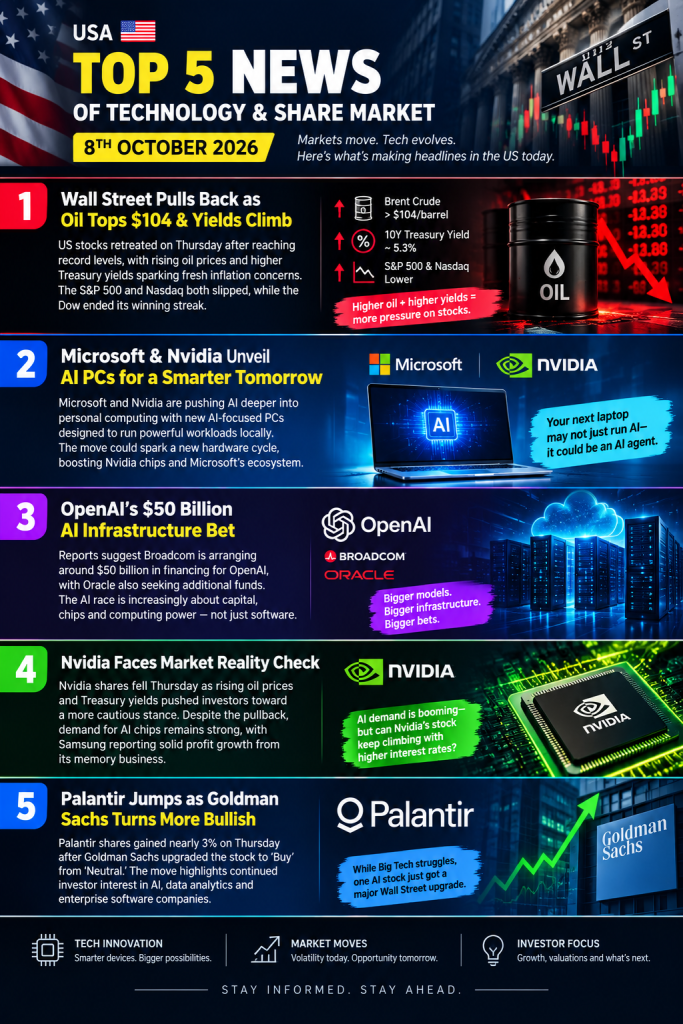
1. 📉 Wall Street pulls back from record highs
U.S. stocks retreated today after recently reaching records. The S&P 500 fell about 0.4%, the Dow about 0.4%, and the Nasdaq about 0.5% during Thursday trading. Nvidia also slipped around 0.6%. (AP News)
Why is this happening?
The biggest concern is a combination of:
- Higher oil prices
- Rising U.S. Treasury yields
- Persistent inflation concerns
- Expectations that interest rates could remain high
- Geopolitical uncertainty surrounding Iran and Middle East energy supplies
The 10-year U.S. Treasury yield moved around 5.27%–5.35%, levels not seen since the early 2000s. Higher yields can make stocks—particularly expensive growth and technology stocks—less attractive because investors can earn more from relatively safer bonds. (AP News)
Investor takeaway:
The long-term AI story hasn’t disappeared, but today’s market shows that macroeconomic factors can temporarily overpower AI enthusiasm.
2. 🤖 AI companies are borrowing billions to build AI infrastructure
One of the most important technology-finance stories today is the enormous amount of money being raised to fund AI infrastructure.
Reports indicate that companies including SpaceX, Broadcom and Oracle are pursuing very large financing arrangements to acquire AI chips and build data-center capacity. Broadcom is reportedly arranging more than $50 billion related to custom AI chips being developed with OpenAI, while SpaceX is seeking around $40 billion to finance Nvidia chips. (The Wall Street Journal)
This is significant because the AI boom is moving beyond software.
The new investment cycle is increasingly about:
AI models → GPUs → data centers → electricity → networking → cooling → financing
That means companies involved in AI infrastructure can potentially benefit even if they aren’t selling an AI chatbot directly.
But there’s also a risk: companies are taking on enormous amounts of debt to finance rapidly changing technology. If AI demand grows as expected, these investments could generate huge returns. If demand disappoints, companies could be left with expensive infrastructure and debt.
Investor takeaway:
AI is becoming not just a software story but a massive capital-investment story.
3. 💻 Microsoft launches a major push toward on-device AI
Microsoft is pushing AI deeper into personal computers.
Microsoft unveiled a new high-performance Surface Ultra laptop using Nvidia’s RTX Spark technology. The broader strategy is to make PCs capable of running more sophisticated AI locally rather than sending every task to cloud data centers. (Reuters)
Microsoft is also introducing technology designed to control what AI agents can access on a computer, addressing an important problem: AI agents need permissions and security boundaries if they are going to perform tasks autonomously.
This could create a new competitive battlefield:
Apple vs Microsoft vs Nvidia vs Intel vs AMD
The traditional PC was primarily about CPU performance. The emerging AI PC market is increasingly about CPU + GPU + AI acceleration + local models + AI agents.
For Nvidia, entering this market could be particularly important because Intel and AMD have historically been dominant in PC processors. (Reuters)
Investor takeaway:
AI may gradually change the PC from a device where users operate software into a device where AI agents perform tasks for users.
4. 🧠 Nvidia-backed startup wants different AI chips to work together
Another interesting infrastructure development today involves Upscale AI, a startup backed by Nvidia.
The company launched Token Fabric, a platform designed to allow data centers to connect AI processors from different chip manufacturers more easily. (Reuters)
Why does this matter?
Today’s AI infrastructure is highly complex. A data center might contain processors from different vendors, each with different networking and software requirements.
If companies can combine different AI chips more efficiently, they may have greater flexibility rather than becoming completely dependent on one supplier.
The potential result is:
More chip choices → easier data-center deployment → potentially lower infrastructure complexity → greater AI computing capacity
This is particularly interesting because Nvidia currently has enormous influence over the AI accelerator market.
Investor takeaway:
The next phase of AI competition isn’t only about who makes the fastest chip. It is also about who controls the infrastructure connecting thousands of chips together.
5. 🏭 AI chip and data-center stocks face a reality check
AI-related stocks have been among the biggest winners of the market’s recent rally, but today investors are becoming more selective.
Stocks including Intel, Marvell, Micron, Coherent, Corning and Dell came under pressure as higher yields and renewed inflation worries interrupted the AI-driven rally. At the same time, some individual AI-related companies continued to attract investors. (Barron’s)
One notable exception was Applied Digital, a data-center company benefiting from AI demand. Its revenue reportedly jumped more than 320% year over year, highlighting how quickly demand for AI infrastructure is translating into actual business growth. (Barron’s)
Another interesting move was Wolfspeed, which surged after securing a $1.5 billion, 30-year financing agreement with the U.S. Department of Defense connected to domestic silicon-carbide production. (Barron’s)
This illustrates an important theme: America’s AI and technology strategy increasingly involves domestic semiconductor and advanced-material supply chains.
📊 What today’s news means for investors
| Theme | Current signal | Why it matters |
|---|---|---|
| 🇺🇸 S&P 500 | ⚠️ Pullback | Record valuations face higher yields |
| 💻 Nasdaq/Tech | ⚠️ Under pressure | Growth stocks sensitive to interest rates |
| 🤖 AI | 🟢 Strong | Infrastructure spending remains enormous |
| 🧠 Nvidia | 🟢 Long-term AI leader, but volatile | Chips remain central to AI expansion |
| 🏢 Data centers | 🟢 Strong demand | AI requires enormous computing capacity |
| 💰 AI financing | ⚠️ Increasing risk | Massive debt is funding infrastructure |
| 🛢️ Oil | 🔴 Rising sharply | Could increase inflation |
| 📈 Treasury yields | 🔴 Very high | Makes bonds more competitive with stocks |
🎯 The big picture
The most important story today isn’t simply “stocks are falling.”
It’s this:
The AI boom is getting bigger, but it is also getting more expensive to finance.
The U.S. technology market is entering a stage where investors will increasingly ask two questions:
1. How much money can AI generate?
2. How much does it cost to build the infrastructure needed to generate it?
That tension between AI growth and financing costs is likely to remain one of the biggest themes for U.S. technology stocks.
This is market news and analysis, not a recommendation to buy or sell any security.


