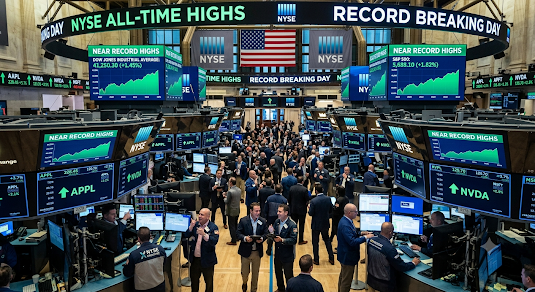
The Numbers
| Index | Level (Oct 1 close) | YTD |
|---|---|---|
| S&P 500 | 7,666.45 | strong gains, trading near all-time highs |
| Nasdaq Composite | 26,871.60 | +15.65% YTD |
| Dow Jones | 50,926.56 | +5.26% YTD |
For context on how far this run has come: the Dow crossed 50,000 for the first time this year, and the Nasdaq has repeatedly set fresh records through 2026, even after a rough patch earlier in the year.
What’s Driving It
1. The AI infrastructure supercycle. This is the dominant story of 2026 markets. Hyperscalers — Microsoft, Google, Amazon, Meta — have collectively guided to roughly $650 billion in capital expenditures for 2026, almost all aimed at AI data centers and chips. That spending has flowed directly into the stocks building the infrastructure:
- Nvidia reclaimed the title of world’s most valuable public company in July 2026, with a market cap around $4.86 trillion, after Jensen Huang revealed Nvidia had overtaken Apple as TSMC’s biggest customer.
- Broadcom has been riding both its own AI accelerator business and a reported $10B chip deal to help OpenAI build custom AI chips.
- Micron reportedly joined the “$1 trillion club” on surging AI-memory demand.
- Chip/AI-infrastructure names like Marvell continue to be a focal point (its Investor Day is today).
2. Sector rotation. Energy and technology have been the best-performing sectors recently; healthcare, real estate, and utilities have lagged — the latter two likely pressured by elevated bond yields making rate-sensitive sectors less attractive.
The Undercurrent of Risk
Nearly every write-up of this rally carries the same caveat: valuations are stretched, and there’s genuine debate about whether this is a sustainable AI-driven re-rating of the economy or a bubble.
- The 10-year Treasury yield has been sitting high (~5.2%), which is unusual alongside record equity highs and adds pressure on rate-sensitive sectors.
- Earlier in 2026, the Nasdaq actually fell into a 10% correction, driven by conflict-related oil price spikes and monetary policy uncertainty — a reminder the rally hasn’t been a straight line up.
- Analysts frequently flag that AI capex is effectively propping up headline GDP and market breadth, meaning a lot of this market’s strength is concentrated in a fairly narrow set of mega-cap tech/AI names rather than being broad-based.
The market is near record highs almost entirely on the strength of an AI infrastructure spending boom among a handful of giant tech companies, with chipmakers (Nvidia, Broadcom, Micron) and cloud hyperscalers as the main engines. The risk flagged consistently by strategists is valuation: if AI capex growth slows, or earnings don’t catch up to the optimism priced into these stocks, the pullback could be sharp — as the earlier-2026 correction already demonstrated.


