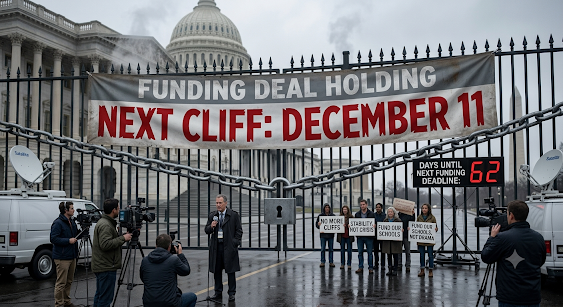
What Happened
On September 2, 2026, President Trump signed a Continuing Resolution (CR) — officially the Continuing Appropriations and Extensions Act, 2027 (H.R. 6500) — that keeps the federal government funded at current (FY2026) levels through December 11, 2026. It passed with strong bipartisan support: 90-6 in the Senate, 370-48 in the House. That’s a notably lopsided, non-partisan vote for Washington these days, which tells you both parties wanted to avoid a third shutdown badly.
Why This Matters — The Backdrop
This isn’t happening in a vacuum. 2026 has already been a brutal year for government funding:
- A 43-day shutdown ran from October 1 to mid-November 2025, after the previous Congress failed to agree on FY2026 funding.
- A 76-day partial shutdown of the Department of Homeland Security ran from mid-February to early May 2026, tied to a dispute over immigration enforcement funding.
- Combined, parts of the government were shut down for roughly 161 days — about 44% of the fiscal year. That’s an extraordinary amount of dysfunction, even by Washington standards.
So when September 30 rolled around again as the next hard deadline, there was real fear of a third closure — made worse by the fact that November 2026 midterm elections were right around the corner, which usually makes Congress more gridlocked, not less.
What’s Actually In the Deal
- Funding stays flat at FY2026 levels — no new spending increases, essentially a “pause” rather than a resolution.
- WIC (the nutrition program for low-income women, infants, and children) gets targeted funding adjustments to keep it running.
- Shipbuilding and national security programs get protected funding.
- The Disaster Relief Fund is funded, which matters for FEMA’s ability to respond to hurricanes, wildfires, etc.
- Defense funding stays at FY2026 levels with a key restriction: no new weapons programs or multiyear contracts can start — this is standard CR boilerplate, but it specifically avoided a scenario where troops would work without pay or civilian defense employees would be furloughed.
- Notably excluded: White House-requested funding for an Iran war supplemental and a $1 billion Trump-class battleship program — Democrats specifically pushed back on these.
- A regulatory provision delays an OMB rule (the “Uniform Guidance” overhaul affecting how federal grants are administered) until December 11 — a relief for universities, research institutions, and nonprofits worried about new red tape.
- Democrats also say they closed a loophole that would’ve let the administration shift money from other programs into Border Patrol funding without additional reform.
What This Means for You, Practically
- Right now: nothing is disrupted. Federal agencies are open, federal employees are being paid, Social Security and Medicare are unaffected (these aren’t subject to annual appropriations anyway), national parks are open, and routine government services (passports, IRS, etc.) are operating normally.
- If you’re a federal employee or contractor: this CR is specifically designed to avoid furloughs and pay disruptions through December 11 — but that protection expires on that date if Congress doesn’t act again.
- If you rely on WIC or disaster relief programs: funding is protected through this window.
- The real deadline to watch is December 11, 2026. Congress now has to use this window to negotiate actual full-year FY2027 appropriations bills — not just another stopgap. Given the House and Senate are still disagreeing over overall funding levels and defense spending specifics, there’s no guarantee a clean deal happens by then, and given this year’s track record (two
Think of this less as “the funding problem is solved” and more as “Congress bought itself ten extra weeks to avoid blame for a shutdown right before the midterms.” The underlying disagreements — overall spending levels, defense priorities, immigration enforcement funding — haven’t been resolved, just postponed. December 11 is the next real test of whether Washington can pass a full-year budget or whether 2026 ends the way it largely played out: funded in fits and starts.


